
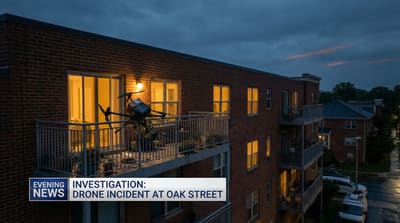
Watch: Amazon Prime Air Drone Crashes Into Texas Apartment — What It Means for Part 108 More videos →
An Amazon Prime Air MK30 delivery drone crashed into the side of an apartment building in Richardson, Texas on February 4th — barely two months after the service launched in the Dallas suburb. A resident caught the entire incident on video, showing the drone drifting into the building, debris raining down, and the aircraft smoking on the ground with propellers still spinning. No injuries were reported, but the incident adds to a troubling pattern that has significant implications for the future of commercial drone delivery in America.
Key Facts
- Aircraft: Amazon Prime Air MK30 delivery drone
- Location: Apartment building in Richardson, Texas (Dallas suburb)
- Date: February 4, 2026
- Injuries: None reported
- Damage: Minimal structural damage to building; Amazon coordinating repairs
- MK30 specs: 5 lb payload capacity, 73 mph cruise speed, 7.5-mile service radius, lithium-ion battery powered
- Service age: Richardson drone deliveries launched December 2025 — less than 2 months before crash
- FAA: Investigating the incident
What the Video Shows
Richardson resident Cessy Johnson was working from home when she heard a drone nearby and started filming — she'd never seen one of Amazon's delivery drones in action. What she captured instead was a crash.
The video shows the MK30 appearing to move slowly and deliberately toward the side of the apartment building. After it passed out of her direct line of sight, Johnson reported hearing unusual noises before fragments of the drone and building debris fell to the ground. The drone itself followed, crashing below with its propellers still spinning.
"The propellers on the thing were still moving, and you could smell it was starting to burn. And you see a few sparks in one of my videos. Luckily, nothing really caught on fire where it got, it escalated really crazy." — Cessy Johnson, eyewitness, to FOX 4 KDFW
The Richardson Fire Department responded. Firefighters reported no fire, though the smoking lithium-ion battery pack was a clear concern. Two Amazon crew members arrived shortly after to dismantle and remove the wreckage. Amazon has stated it is coordinating minor repairs to the building. The swift emergency response highlights the importance of proper safety protocols when drones operate over populated areas.
A Pattern Emerges: The MK30 Incident Timeline
The Richardson crash isn't an isolated event. It's the latest in a series of MK30-related incidents stretching back to late 2025, and the pattern is becoming difficult to ignore.
MK30 Incident History
Oct 2025 Tolleson, Arizona: Two MK30 drones struck the same construction crane boom within minutes of each other. Debris fell into two nearby parking lots. NTSB launched investigation. AOPA cited this incident as evidence the FAA is moving too fast on Part 108.
Nov 2025 Waco, Texas: An MK30 clipped an internet cable, suffering minor propeller damage upon executing a "safe contingent landing" (SCL). NTSB elected not to investigate.
Feb 2026 Richardson, Texas: MK30 collided with apartment building, fell to ground smoking. Fire department responded. FAA investigating. Amazon coordinating building repairs.
Three incidents involving the same drone model in less than five months, raising questions about whether the FAA's enforcement posture will intensify in response. Two in Texas. One where the same obstacle was struck twice in rapid succession. These aren't random — they suggest systemic issues with either the MK30's sense-and-avoid systems, its operational flight planning, or both.
How the MK30 Is Supposed to Work
Amazon's MK30 is the company's flagship delivery drone — a hexacopter with staggered tandem wings designed for efficient forward flight. It carries packages up to 5 pounds, cruises at approximately 73 mph, and typically operates at 200-300 feet AGL within a 7.5-mile service radius. Packages are released from approximately 13 feet above the delivery point.
Critically, the MK30 is equipped with what Amazon calls a "safe contingent landing" (SCL) system. When the drone encounters unexpected weather, obstacles, air traffic, or system failures, it's designed to transition from forward to vertical flight and use onboard perception systems to identify a clear landing spot.
In the Richardson incident, Amazon stated the drone was in vertical flight mode at the time of the crash but notably did not mention whether the SCL procedure had been activated. This omission raises questions: did the sense-and-avoid system fail to detect the building? Was the drone already in a degraded state? Amazon's investigation will need to answer these questions.
The Part 108 Elephant in the Room
The timing of these incidents could not be worse for Amazon — or for the broader drone delivery industry. The FAA is currently weighing its proposed Part 108 rule, which would dramatically expand commercial drone operations by allowing detect-and-avoid (DAA) technology to substitute for human visual observers in beyond visual line of sight (BVLOS) operations.
Part 108 is the regulatory key that unlocks scaled drone delivery, building on the BVLOS operational framework the industry has been developing. Without it, companies like Amazon, Walmart's Wing partner, and Zipline must operate under individual waivers and exemptions — a slow, site-by-site process that can't scale nationally.
The Aircraft Owners and Pilots Association (AOPA) has already seized on the MK30's track record in its formal comments on the Part 108 proposal:
"While there were no injuries, the resulting debris fell into two nearby parking lots. The fact that two drones crashed within minutes of each other, into the same obstacle, would seem to indicate that a systemic problem exists that must be examined and addressed." — AOPA, formal comments on proposed Part 108 rule
In an unusual move, the FAA in January reopened the public comment period on Part 108, giving stakeholders until February 5th — one day after the Richardson crash — to submit additional feedback. Whether the Richardson incident will prompt further delays or revisions remains to be seen, but it gives ammunition to those arguing the industry isn't ready.
UAVHQ Analysis: What This Means for Drone Operators
1. The Safety Record Will Define the Timeline
Every MK30 crash pushes the Part 108 timeline to the right. The FAA is under enormous pressure from both sides — industry wants faster adoption, while pilots' groups and the public want proof these systems work. Each incident that generates video footage on the evening news adds months to the regulatory process. Amazon's safety record isn't just Amazon's problem; it's the entire delivery drone industry's problem.
2. Lithium-Ion Battery Risk Is Underappreciated
The smoking wreckage in Richardson highlights a risk that doesn't get enough attention: lithium-ion battery thermal events. A drone crashing into a building is bad. A drone crashing into a building and starting a lithium fire is catastrophic. The industry needs to take battery containment and fire suppression more seriously, especially for drones operating over populated areas.
3. Sense-and-Avoid Needs to Actually Work
An apartment building is not a hard object to detect. It's large, stationary, and mapped. If the MK30's perception systems couldn't avoid a building in suburban Richardson, that raises fundamental questions about whether current DAA technology can handle the dynamic obstacles — birds, temporary structures, other aircraft — that Part 108 operations would encounter. The Tolleson crane incident tells a similar story: two drones hitting the same fixed obstacle suggests the obstacle was either undetected or misclassified.
4. Community Acceptance Is Fragile
Richardson only had drone delivery for two months before a drone crashed into an apartment building. Cessy Johnson went from curious first-time observer to crash witness in a single afternoon. Community buy-in is essential for drone delivery to scale, and each incident erodes it. Operators — not just Amazon — need to recognize that public trust, once lost, is extraordinarily difficult to rebuild.
5. Operators: Watch the NTSB Response
The NTSB investigated the Tolleson crane strikes but passed on the Waco cable clip. Their response to the Richardson crash will signal how seriously they view the pattern. A formal investigation would put the MK30's DAA system under microscope-level scrutiny and could result in recommendations that affect all commercial drone operations, not just Amazon's.
Amazon's Expansion vs. Amazon's Track Record
Despite the incidents, Amazon is pressing ahead with expansion. Prime Air currently serves customers in Richardson, Texas and Tolleson, Arizona, with plans to add additional locations in Texas, Missouri, and Michigan. The company's stated goal is to make drone delivery a routine part of the Prime experience.
The tension is obvious: Amazon is scaling operations while its flagship drone is compiling an incident record that its competitors and critics are documenting carefully. Walmart and DoorDash are also pushing drone delivery, meaning the regulatory environment Amazon helps shape — for better or worse — affects everyone.
"We apologize for any inconvenience and are actively investigating the cause of this incident." — Amazon spokesperson Terrence Clark
"Any inconvenience" is doing a lot of heavy lifting in that statement. A drone crashing into the building where you live, smoking on the ground with spinning propellers, isn't an inconvenience. It's the kind of event that makes people oppose drone delivery in their neighborhoods — and contact their representatives about it.
The Bottom Line
The Richardson crash isn't going to kill drone delivery. The technology is too promising and the economics too compelling — and expert consulting guidance can help operators navigate the safety and regulatory challenges ahead. But it should be a wake-up call — for Amazon, for regulators, and for an industry that sometimes confuses moving fast with being ready.
Three MK30 incidents in five months. Each one more public than the last. The drone delivery industry needs the Richardson crash to be a turning point in safety culture, not just another data point in a troubling trend. Because the next crash might not end with "no injuries reported."
Amazon Prime Air MK30 Drone Delivery Richardson TX Part 108 BVLOS FAA NTSB AOPA Safety Sense and Avoid
Sources
FLYING Magazine — Amazon Drone Suffers Another Crash in Texas AVweb — Amazon Drone Crashes Into Texas Apartment Building FOX Business — Amazon Prime Air drone crashes into Texas apartment building FOX 4 Dallas-Fort Worth — VIDEO: Amazon delivery drone crashes in North Texas FLYING Magazine — Breaking Down the BVLOS Drone Proposal (Part 108)
📺 Watch the Video Briefing
Get expert video analysis on this topic and more on the UAVHQ YouTube channel.
🚁 Stay Ahead of the Drone Industry
Expert analysis on FAA regulations, commercial operations, and emerging technology — delivered to your inbox.
Subscribe
Consulting Intake Paused
UAVHQ is not currently accepting new consulting clients. Existing commitments remain supported; select time-sensitive safety or regulatory inquiries may be reviewed as availability allows.
Sponsored by
Your Brand Here
Reach drone professionals, commercial operators, and aviation decision-makers.
📺 Watch the Video Briefing
Get expert video analysis on this topic and more on the UAVHQ YouTube channel.
🚁 Stay Ahead of the Drone Industry
Expert analysis on FAA regulations, commercial operations, and emerging technology — delivered to your inbox.
Subscribe
Sponsored by
Your Brand Here
Reach drone professionals, commercial operators, and aviation decision-makers.
UAVHQ
Drone industry intelligence and professional UAV consulting from Wesley Alexander — Senior Test Pilot with 25+ years of aviation leadership.
Explore
Connect
© 2026 UAVHQ. All rights reserved. · Privacy Policy