
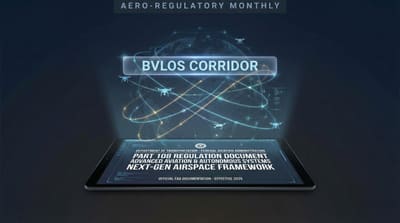
Status updated September 2, 2026: FAA Part 108 remains a proposed rule. Earlier wording on this page included an expected final-publication date that passed without a final rule. This guide now distinguishes the NPRM from current operating authority.
Part 108 in one sentence
The FAA and Transportation Security Administration have proposed a new performance-based framework for routine low-altitude UAS operations beyond visual line of sight, along with supporting aircraft, operator, security, recordkeeping, and automated-data-service requirements.
The proposal was published in the Federal Register on August 7, 2025 under docket FAA-2025-1908. The docket later received a limited reopening of the comment period. As of this update, the Federal Register still lists the action as a notice of proposed rulemaking.
What Part 108 does not do today
Part 108 does not currently authorize a flight. Proposed language is not an issued permit, operating certificate, waiver, exemption, or COA. Operators must continue using the authority applicable to their present operation.
It is also too early to promise customers a precise compliance date, approved equipment list, transition period, or final means of compliance. Those details depend on final regulatory text and subsequent implementation material.
The framework FAA proposed
The NPRM seeks to replace part of the case-by-case BVLOS approval burden with repeatable authorization pathways. The proposal covers several connected layers.
Operating authorization
FAA proposes different authorization paths based on the scale and risk of the operation. Lower-risk operations would use a permit structure, while higher-risk operations would require an operating certificate and additional organizational oversight.
Aircraft and system qualification
The proposal describes performance-based acceptance and declaration mechanisms rather than treating every uncrewed aircraft like a conventionally type-certificated crewed aircraft. Exact final standards and accepted means of compliance remain implementation questions.
Separation and detect-and-avoid
A BVLOS operation needs a defensible method to manage traffic conflict. The NPRM addresses strategic deconfliction, conformance monitoring, electronic awareness, and detect-and-avoid responsibilities. Operators should treat every specific equipage outcome as proposed until final language and accepted standards are published.
Automated data services
The proposal includes a new framework for automated data service providers that could support strategic deconfliction and conformance monitoring. This matters because the safety case may depend not only on the aircraft and control station, but also on external services, data quality, availability, latency, and failure behavior.
Security, records, and reporting
FAA and TSA propose complementary requirements for operator responsibility, records, reporting, and security. Mature programs should expect traceability: who was responsible, which configuration flew, what supporting services were available, what failed, and what the organization did about it.
The operator-readiness stack
The safest preparation work is useful whether the final rule changes substantially or not.
1. Define the real ConOps
Document the aircraft, operating area, route structure, altitude, airspace classes, population exposure, crew positions, dispatch model, communications links, navigation sources, surveillance inputs, recovery sites, and mission-abort logic.
A vague ambition to “do BVLOS” is not a testable operation.
2. Build a current-authority matrix
For each planned profile, record the authority required today. Keep a separate column for proposed Part 108 assumptions and another for unresolved questions. This prevents a future-rule concept from leaking into current flight-release decisions.
3. Measure command-and-control performance
Collect availability, latency, coverage, handover, interference, and lost-link evidence in the actual operating environment. Define when the system continues, holds, reroutes, returns, or terminates.
4. Treat DAA as a system
Traffic surveillance, alerting, maneuver logic, communications, crew procedures, airspace assumptions, and contingency behavior have to work together. Buying one sensor does not produce a complete safety case.
5. Establish configuration control
Track aircraft hardware, payload, software, firmware, control-station configuration, navigation data, communications equipment, supporting services, and approved operational limitations. If the team cannot reconstruct the configuration, it cannot reliably explain performance.
6. Build training around decisions
Training should cover more than manipulation of controls. Crews need clear decision standards for dispatch, weather, degraded communications, surveillance uncertainty, airspace changes, emergency response, and maintenance discrepancies.
7. Prepare the record system
Maintenance, training, duty, flight, configuration, safety-reporting, and corrective-action records should be structured before scale. Retrofitting traceability after an incident is considerably harder.
Questions vendors should answer
- Which proposed requirement is the product intended to support?
- What current approvals or accepted standards support that claim?
- What operating assumptions bound the performance data?
- How does the system signal degraded or unavailable service?
- Which interfaces and logs are available to the operator?
- What changes require revalidation?
- What part of the safety case remains the operator's responsibility?
A roadmap slide is not regulatory acceptance.
Questions leadership should answer
- Which BVLOS profile creates enough value to justify the compliance burden?
- What authority supports the operation before a final rule exists?
- Which investments are useful under several plausible final outcomes?
- What evidence must exist before a customer commitment or launch date is credible?
- Who owns operational risk when an aircraft, communications link, data service, or procedure degrades?
Current timeline
Verified milestones:
- August 7, 2025: joint FAA/TSA NPRM published.
- September 29, 2025: FAA denied a general extension of the initial comment period.
- February 10, 2026: notice reopening a limited portion of the comment period published.
- September 2, 2026: Federal Register docket still identifies Part 108 as proposed; no final-rule effective date is asserted here.
Official sources
- FAA: Beyond Visual Line of Sight proposed rule
- Federal Register docket and NPRM
- FAA BVLOS NPRM PDF
- FAA Drone Integration Concept of Operations
The practical conclusion
Prepare the durable operating system now: ConOps, records, configuration control, training, communications evidence, DAA strategy, emergency procedures, and organizational accountability. Keep every proposed requirement labeled as proposed until the FAA publishes final text.
For a structured planning framework, see the Part 108 BVLOS Readiness Playbook.