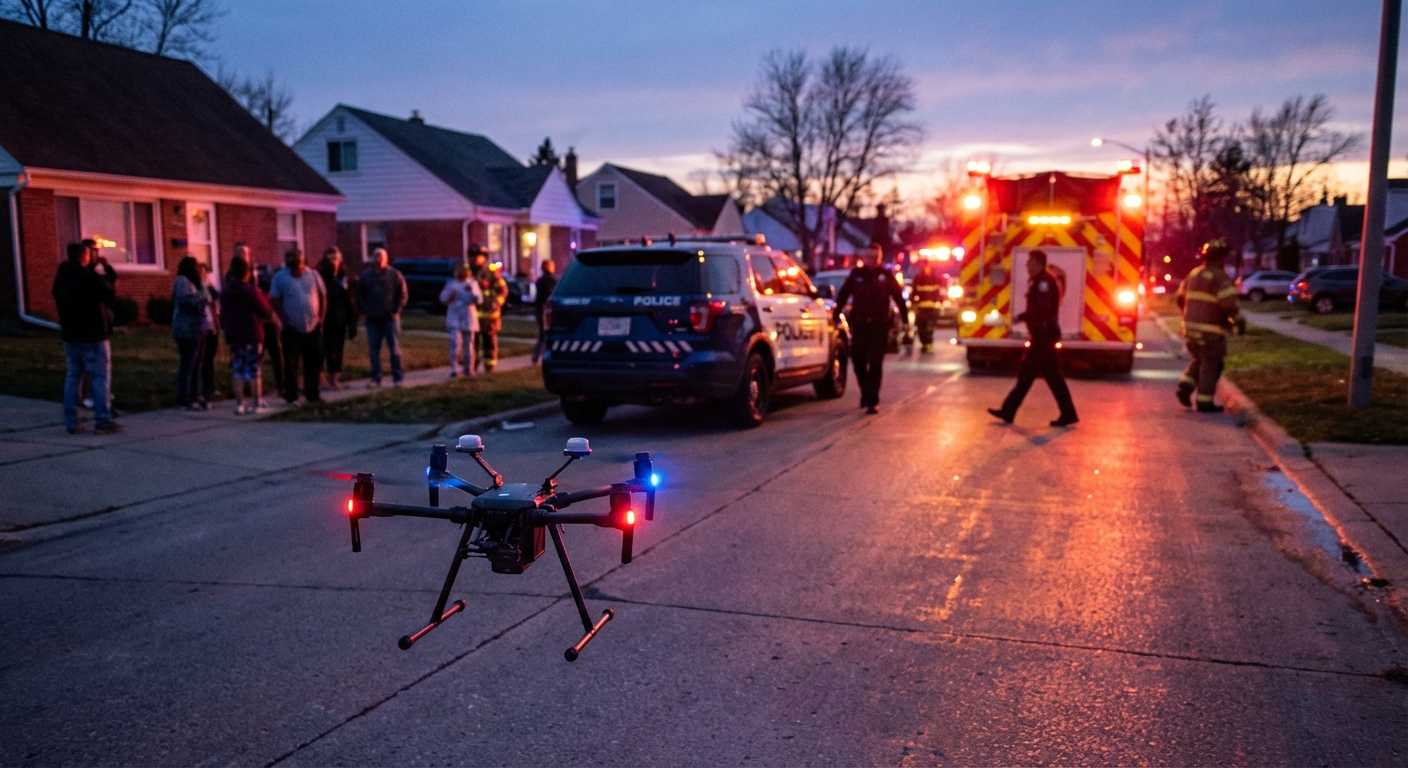
The City of Warren, Michigan has launched the first municipal drone program in the state to combine police and fire emergency response under a unified command structure, operating under special FAA waiver authority that enables 6-mile operational radius and rapid deployment to emergency scenes.
Breaking New Ground in Public Safety Aviation
Warren's drone first responder (DFR) program represents a significant evolution in municipal emergency response, combining law enforcement and fire department operations under a single, coordinated aerial platform. The program, which went operational in early March 2026, leverages special FAA waiver authority to provide real-time intelligence before ground units arrive on scene.
According to Warren Police Commissioner Eric Hawkins, the program is already transforming how the city responds to emergencies. "This is just another tool that allows us to leverage technology," Hawkins said, noting that the integration allows both departments to "operate much more impactful and serve this community in a way that no other communities in terms of public safety are being served in this country."
Technical Specifications and Operational Capabilities
The Warren DFR program operates from seven strategic locations: six fire stations throughout the city and Warren Police Headquarters. Under the FAA waiver, remote licensed pilots can deploy drones up to 6 miles from base stations at speeds reaching 45 miles per hour, dramatically reducing response times compared to ground units.
The drones provide live video feeds directly to incident commanders and responding units, offering critical situational awareness before personnel arrive on scene. This capability is particularly valuable for high-risk scenarios including search and rescue operations, building fires, and officer safety situations.
"It's really hard to send an officer back behind a dumpster enclosure; it's really hard to send an officer in a big open wooded area where you don't know what you're walking into. These drones can take part of that risk off of an officer and can provide them real-time intelligence on the ground, and can lead to better outcomes." — Lt. Brandon Roy, Warren Police Department
Dual-Agency Integration: A Regulatory Achievement
What sets Warren's program apart is not just the technology, but the regulatory framework enabling unified police and fire operations. Obtaining FAA waiver authority for dual-agency drone operations typically requires extensive coordination and safety planning, as federal aviation regulations treat each public safety entity as a separate operator.
Warren Fire Department Commissioner Wilbert McAdams emphasized the tactical advantages: "Having an overview of the scene can help guide us to deploy our assets effectively." For structure fires, aerial reconnaissance can identify potential hazards, optimal entry points, and resource deployment areas before firefighters enter dangerous environments.
Operational Benefits by Department
Law Enforcement Applications:
- Perimeter security and suspect tracking
- Scene reconnaissance for officer safety
- Search and rescue coordination
- Traffic accident documentation
- Crowd monitoring during special events
Fire/EMS Applications:
- Structure fire assessment and ventilation planning
- Hazardous material incident monitoring
- Wildland fire perimeter tracking
- Search and rescue in difficult terrain
- Medical emergency scene security
Community Response and Real-World Performance
Early community feedback has been overwhelmingly positive. Warren resident Christina Wright experienced the program firsthand during a medical emergency. "I just had an emergency situation at my house yesterday morning and seen the drones there. My husband had a bad asthma attack. The fire department came, and the police came. They were there within seconds and saw the drones there too," Wright reported.
Fellow resident Gary Drescher noted the public safety implications: "I think anything that gets us a faster police response or emergency response is a good thing. Faster the response, the better. I think lives will be saved and get the bad guys off the streets."
Industry Implications: The Future of Municipal Aviation
Warren's success could serve as a blueprint for other municipalities seeking to modernize emergency response capabilities. The unified command structure addresses a common challenge in public safety drone operations: jurisdictional coordination between agencies that traditionally operate independently.
Several factors make Warren's model potentially replicable:
- Regulatory Precedent: The FAA waiver demonstrates federal willingness to support innovative municipal aviation programs
- Cost Efficiency: Shared infrastructure and personnel reduce per-agency costs
- Operational Synergies: Many emergency scenarios require both police and fire response
- Technology Maturation: Modern drone platforms offer the reliability and range necessary for professional operations
Navigating the 2026 Enforcement Environment
Warren's program launches amid heightened FAA enforcement activity in 2026, with the agency pursuing more aggressive penalties for unauthorized drone operations. The contrast is stark: while rogue operators face fines up to $75,000 per violation, properly authorized public safety programs like Warren's receive expanded operational authority.
This regulatory environment reinforces the importance of proper authorization and professional operation standards. Municipal programs seeking similar capabilities should expect rigorous FAA scrutiny of safety procedures, pilot qualifications, and operational protocols.
Looking Forward: The DFR Model Expands
As Warren's program demonstrates operational success, other Michigan municipalities are likely to pursue similar capabilities. The state's investment in drone technology infrastructure, including the National Advanced Drone Warfare Center designation, provides a supportive environment for continued innovation.
For drone industry professionals, Warren's program represents growing opportunities in the public safety sector. Key growth areas include:
- Training and certification for public safety pilots
- Specialized equipment for emergency response applications
- Integration services for multi-agency operations
- Data management and sharing platforms
Key Takeaways for Drone Operators
Warren's success underscores several critical factors for professional drone operations in 2026:
Regulatory Compliance is Non-Negotiable: The FAA's enhanced enforcement posture makes proper authorization essential, but also demonstrates the benefits of working within the system.
Multi-Agency Coordination Creates Opportunities: Programs that solve operational challenges for multiple stakeholders can justify regulatory flexibility and funding.
Real-World Performance Matters: Warren's program succeeded because it delivers measurable operational benefits, not just technological capabilities.
As Mayor Lori Stone noted, "This investment helps us be more efficient, be more effective, and have better outcomes for Warren residents." For the drone industry, that outcome-focused approach offers a roadmap for continued growth in the public safety sector.