Vanderbilt Campus DFR: The Reality Check Behind the Launch
A field-facing package for Drone First Responder teams: what the Vanderbilt Skydio X10 launch says about dispatch integration, LAANC timing, Operations Over People, maintenance records, training, privacy governance, and public-trust discipline.
May 2026 DFR, Part 107, LAANC, OOP, campus security Author: Wesley Alexander — Former Insitu/Boeing ScanEagle Commercial Chief Test Pilot
01 — Video Briefing
Vanderbilt's Drone First Responder Program: What They Don't Tell You
02 — What You Need to Know
5 Key Takeaways
The Drone Is the Easy Part
A docked X10 can launch quickly. The program succeeds only if dispatch, airspace, maintenance, training, and governance move at the same speed.
CAD Integration Decides Response Time
Manual launch decisions create friction. DFR needs call-type rules, automated triggers, operator authority, and an audit trail tied to the dispatch record.
LAANC Is a Real-Time Constraint
Campus DFR near controlled airspace has to coordinate authorization, ceilings, ATC restrictions, and mission urgency without burning the response window.
OOP Is a Safety Case, Not a Sticker
Parachutes help. They do not replace documented category limits, maintenance records, crew procedures, crowd rules, and risk controls.
Trust Is Operational
Every flight needs a public-safety purpose, defensible retention policy, review cadence, and clear boundary against routine surveillance.
03 — Launch Blueprint
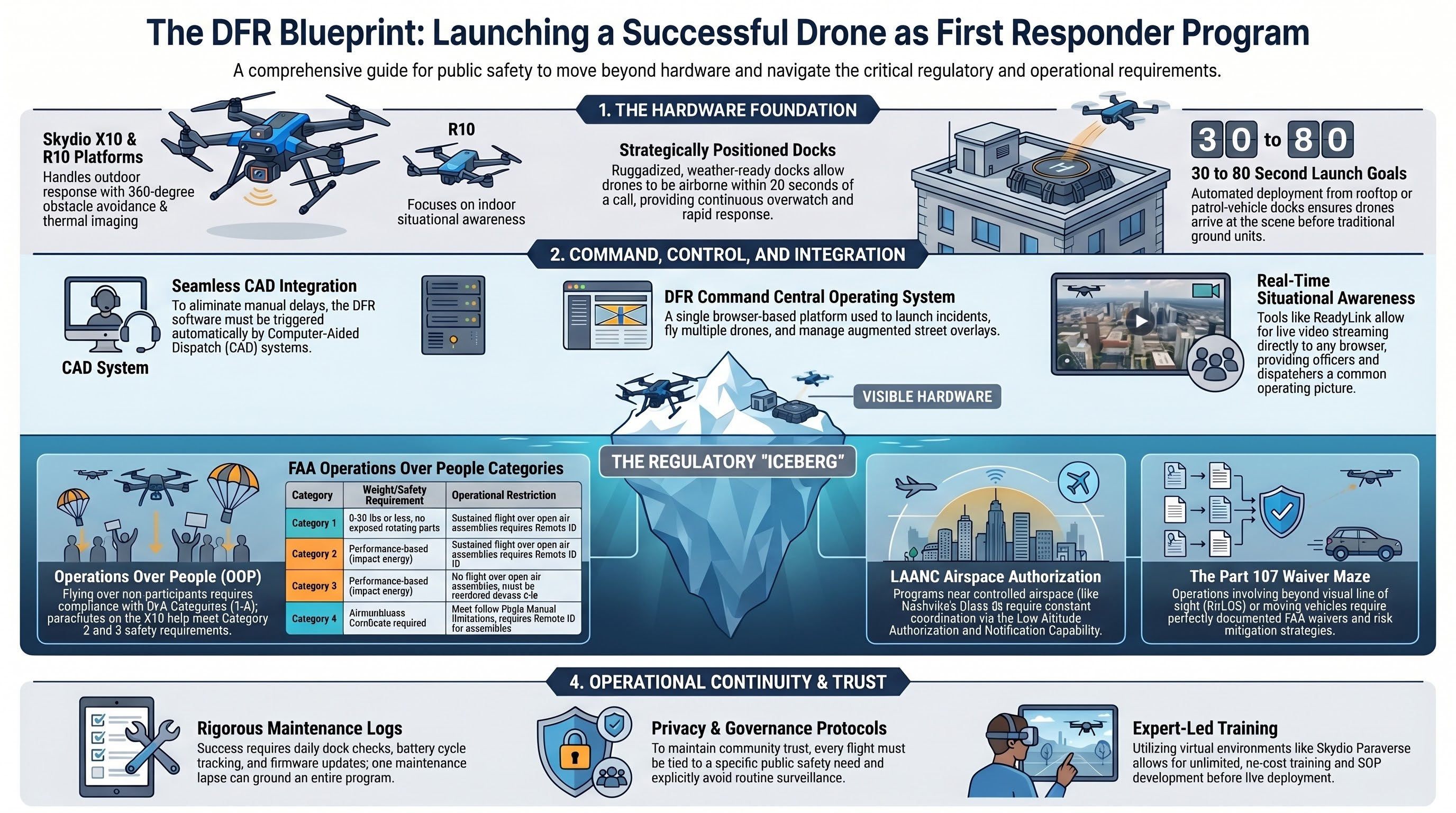
The DFR Program Launch Blueprint
Click to preview the full-size visual supplement in a shadowbox · The DFR Blueprint: Launching a Successful Drone as First Responder Program
04 — PDF Briefing
The DFR Reality Check
Companion PDF for building a campus/public-safety DFR program around more than hardware: launch conditions, authorization layers, maintenance control, governance, and operational continuity.
📄
DFR Reality Check PDF
The video and blueprint stay open. The operator PDF is now the email-capture asset for campus, public-safety, and critical-infrastructure DFR launch teams.
Operations Over People category limits, parachute readiness, crowd/event procedures, and emergency termination logic.
Program Governance
Maintenance logs, battery cycles, firmware control, training currency, data retention, flight review, and privacy boundaries.
06 — Operator Checklist
Before You Copy the Vanderbilt Model
Define which call types can trigger a DFR launch and who can override the launch decision.
Map every dock location against controlled airspace, UAS facility-map ceilings, LAANC availability, and emergency escalation procedures.
Build an Operations Over People file that ties aircraft configuration, parachute status, category limits, and crowd/event rules to each mission type.
Decide whether the operating model is VLOS, visual-observer-supported, shielded, BVLOS-waiver-based, or COA-based before promising campus-wide coverage.
Create daily dock, battery, firmware, parachute, and discrepancy logs that can survive an FAA or public-records review.
Publish the governance boundary: no routine surveillance, every flight tied to a public-safety purpose, retention rules, and review cadence.